

by Michael Langhans, Executiv Director FOREF Germany, Legal Expert
First spoken on 09/0372026 during CEFoRB
„If, like me, you have spent ten years working on new religious movements in Germany — and have also represented people in these communities in court — you see far more than I could ever share in one talk like this.
socially stigmatized groups
Normal rule-of-law and press standards do not apply in cases about so-called "cults." I have decided to stop using the word "cult" and instead say "socially stigmatized groups." This puts the focus back on the outside world — on who is doing the labeling. Because that's really what happens: someone, whether a former member, the press, or the courts, puts a stigma on a group and its people.
We see a kind of reversed burden of proof. It is not the state that must prove guilt — it is the stigmatized person who must prove they did nothing wrong. This happens both in the media and in court.
Members of Groups like Go&Change get branded with labels such as "profession: guru." Member of the Order of the Transformants is called "self-appointed prophet." People even claim the Order has no legal standing because it is not "officially recognized." A public prosecutor should really know that the Weimar Constitution, read together with the German Basic Law, says something different.
In the same way, officials often seem unaware of how European Union law applies to cross-border cases. Even though the European Court of Justice has ruled clearly on this, attempts were made to bring criminal charges — for "taking children away" — against members of the Twelve Tribes and Go&Change. These charges go against the European right of free movement.
Former members are always believed,
members of stigmatized groups are always doubted.
Experts linked to established churches are often the loudest critics of their "competition." They talk about manipulation and pressure without having real training in psychology.
There's an unwritten rule: former members are always believed, and members of stigmatized groups are always doubted.
This is both a tradition and an injustice.
Studies show that even trained lie detectors — professionals whose job is to judge truth from lies — are right only 45 to 60 percent of the time, barely better than a coin flip. As the researcher Vrij points out, the real difference is that these "experts" wildly overestimate their own skill.
Solutions
But this speech isn't only about criticism. It's also about solutions.
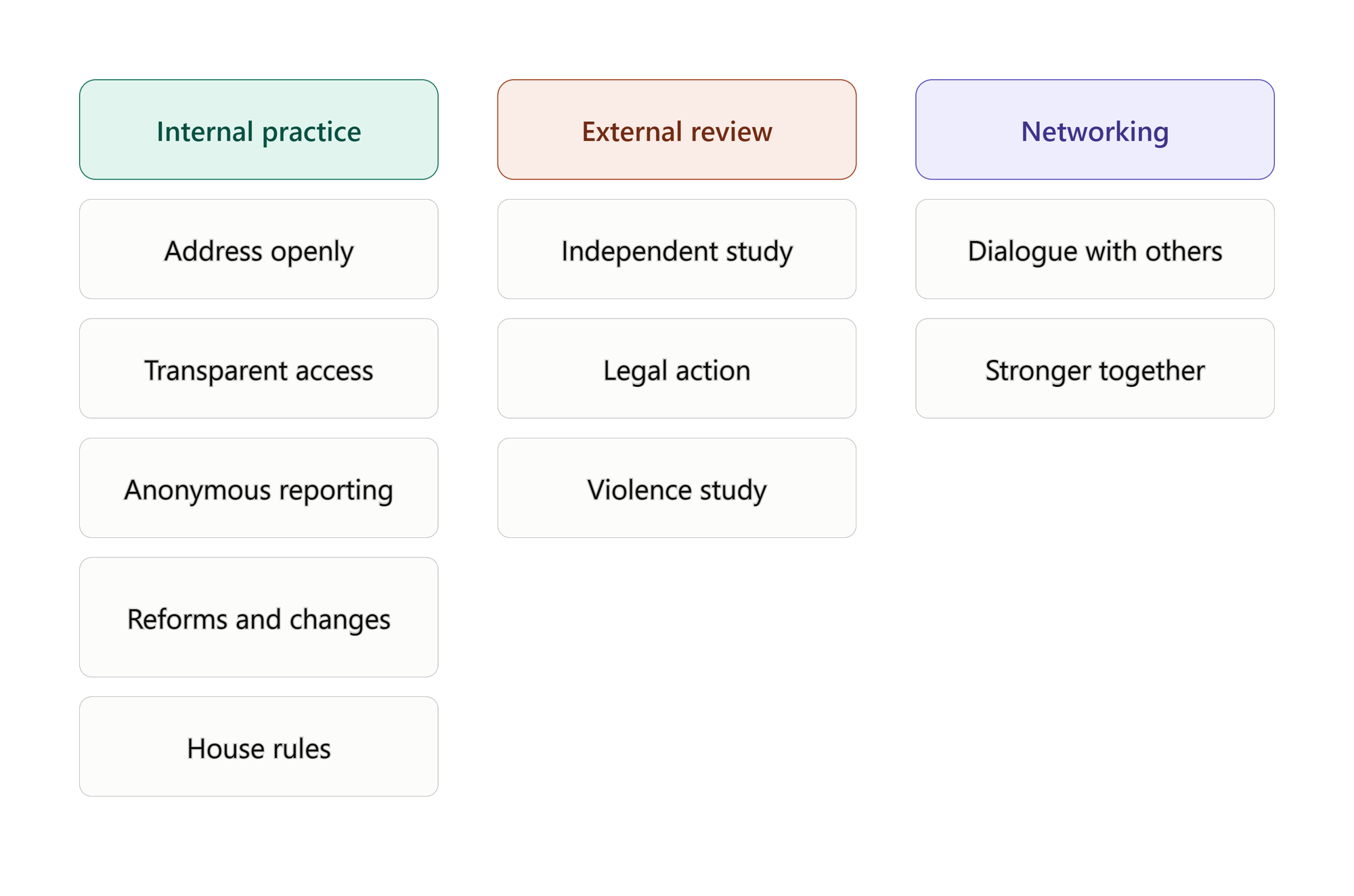
Intern Practise
- Communities need to handle accusations openly, without becoming defensive.
- They should give access to information without trying too hard to please.
- And they should build their own system of internal checks. At FOREF, we set up an anonymous reporting system in 2026 for concerns about specific communities, free of charge.
Anyone, from inside or outside, can use it without registering. We review each report fairly and raise it with the community's leaders, aiming for a helpful way out of the same old stories, avoiding conflict, solving problems. - We recommend that religious communities include a clear commitment to the current constitution as one of their basic house rules.
- We also recommend they carefully write down any changes they make in response to problems or outdated practices. Every way of life adapts over time — but a group needs proof of that adaptation if it's ever questioned later.
 Peter Zöhrer
 Michael Langhans
External Review
- When negative press coverage becomes the main story, it can help to carry out an independent, science-based review. This means looking closely — using psychology, sociology, and law — at whether a group is truly harmful. Such a review should draw on press coverage, official records, and statements from current members, outside observers, and former members alike. We are working on Go&Change with exactly this kind of detailed report, to balance out one-sided press statements and create some encyclopedia of allegations against a group.
- Legal action against knowingly false claims, or other unfair outside interference, can also be an important, but slow and expensive, tool.
- And here's something I hope for, looking at groups like Shincheonji, Unification Church and others: a proper, systematic study of violent forced "deprogramming" or violence used against members of these Christian communities. In my experience, this happens far more often than the low numbers of negative stories from apostates would suggest. Numbers are important to show whats really going on.
 Michael Langhans
Networking
But the most important step was taken by us just a week and a half ago, here in Germany: bringing socially stigmatized groups together with other religious communities at the same table, in the same room — which is exactly what CEFoRB stands for.
the first stone thrown hurts the most
Only this way we show the bigger pattern at work. Not every injustice is the same, of course.
But the first stone thrown hurts the most — and while twenty matchsticks together cannot be broken, anyone can snap them one by one. The more matchsticks, the better, i suggest.

Thank you for your attention.“
Note:
Since the foref.info website is primarily in German, it will take some time before all the linked information is also available in English.
If you are interested in one of our solutions or need more information in English, please feel free to contact me at langhans@foref.info.


